Breathing or swallowing difficulty, heavy bleeding that will not stop, and a knocked-out adult tooth lead this ranking of urgent dental symptoms in Whitechapel. This 2026 guide explains when you need hospital help, when to contact Emergencysmiles for emergency dental care, and what to do while arranging help.
- Urgent dental symptoms Whitechapel: breathing or swallowing difficulty needs emergency hospital help, not a routine dental booking.
- A knocked-out adult tooth needs immediate dental attention; handle the crown, never the root.
- Emergencysmiles provides emergency dental care in Whitechapel, with same-day and out-of-hours appointments.
- Severe toothache, facial swelling and dental injuries need prompt assessment; symptoms alone cannot confirm the cause.
Why this matters
Toothache can be exhausting, but pain alone does not tell you how dangerous a dental problem is. Swelling affecting your breathing is more urgent than an extremely painful tooth without those warning signs.
Emergencysmiles is for patients needing same-day emergency dental care in Whitechapel. Hospital emergency care takes priority when dental symptoms threaten your breathing, involve serious facial injury or cause uncontrollable bleeding.
This ranking helps you choose the right next action. It does not diagnose an infection, tell you whether a tooth can be saved or replace an examination.
What determines how urgent a dental symptom is?
Use these checks before comparing symptoms. The highest-risk sign determines your next step, even when another symptom hurts more.
- Breathing and swallowing: difficulty with either needs immediate emergency help.
- Bleeding control: heavy bleeding that continues despite firm pressure needs emergency assessment.
- Time-sensitive injury: a knocked-out adult tooth needs immediate action to give it the best chance of survival.
- Swelling and illness: spreading swelling, fever or feeling unwell increases the urgency of dental assessment.
- Pain and damage: pain disrupting sleep, a broken tooth or exposed sensitive tissue needs prompt dental attention.
Do not treat this as a countdown. You do not need every warning sign before asking for help, and a lower-ranked symptom moves up the list when serious signs develop alongside it.
Urgent dental symptoms at a glance
The table ranks symptoms by the action they demand, rather than by how painful they feel. Use it as a 2026 decision guide, not permission to delay care when your condition changes.
| Rank | Symptom or situation | Best next step | Why it matters | Important limit |
|---|---|---|---|---|
| 1 | Difficulty breathing or swallowing with mouth or neck swelling | Call 999 | Your airway needs immediate protection | A dental appointment must not delay emergency help |
| 2 | Heavy mouth bleeding that will not stop, or serious facial injury | A&E; call 999 for a life-threatening emergency | Bleeding or injury needs emergency assessment | A small amount of blood-stained saliva is different from heavy bleeding |
| 3 | Knocked-out adult tooth | Seek a dentist immediately | Prompt action improves the chance of saving the tooth | Never put a baby tooth back in |
| 4 | Facial or gum swelling, especially with fever | Urgent dental assessment | An infection needs assessment and treatment | Breathing, swallowing or eye symptoms change the route to hospital |
| 5 | Severe or persistent toothache | Same-day dental assessment | The cause needs treatment, not just temporary pain control | Pain intensity does not identify the cause |
| 6 | Broken tooth with pain or injury | Prompt dental assessment | Damage can expose sensitive tissue | Serious facial injury belongs higher in this ranking |
| 7 | Lost filling or crown with sensitivity | Contact a dentist for advice and assessment | The exposed tooth needs checking | Severe pain or swelling makes it more urgent |
1. Breathing or swallowing difficulty: emergency help first
Swelling in your mouth, throat or neck becomes a medical emergency when it affects breathing or swallowing. Difficulty speaking, rapidly increasing swelling or being unable to swallow your saliva also needs immediate attention.
Call 999 if you have breathing difficulty or a life-threatening emergency. Do not wait for a dental appointment, a callback or painkillers to work. Do not drive yourself to A&E.
The benefit of emergency hospital care is access to assessment and treatment for threats to your airway. Its purpose is not to replace the later dental care needed to address the source.
- Best next step: emergency medical help now.
- Helpful while waiting: follow the emergency call handler’s instructions and have someone stay with you if possible.
- Avoid: attempting to drain swelling or putting anything into your mouth that interferes with breathing.
Action verdict: seek emergency help immediately.
2. Uncontrolled bleeding or serious facial injury: attend A&E
Heavy bleeding from your mouth that does not stop needs emergency assessment. Serious injury to your face or jaw also belongs in hospital, particularly after a significant fall, collision or blow.
A little blood mixed with saliva is not the same as continuous heavy bleeding. If the bleeding is from an accessible area and you can breathe normally, apply firm pressure with clean gauze while arranging help.
Go to A&E for heavy bleeding that will not stop; call 999 if the situation is life-threatening. Fainting, breathing difficulty or a serious associated injury makes calling for emergency help especially important.
- Best next step: hospital assessment for uncontrolled bleeding or serious injury.
- Benefit: assessment can address injuries beyond the teeth and gums.
- Limit: dental follow-up can still be necessary after the immediate emergency is managed.
Do not repeatedly disturb the bleeding area to check it. Tell the treating team if you take blood-thinning medication, but do not stop prescribed medicine without medical advice.
Action verdict: do not wait for a routine dental slot.
3. A knocked-out adult tooth: contact a dentist immediately
A completely knocked-out adult tooth is time-sensitive, even if the bleeding settles or the pain seems manageable. Getting dental help within 60 minutes gives the tooth a better chance of being saved; act immediately rather than treating that time as a waiting allowance.
Hold the tooth by its white crown, not the root. If dirty, rinse it gently in milk, saline or saliva without scrubbing it. If it slides back easily and the person is conscious and able to cooperate, an adult tooth can be placed back in its socket; never force it.
If you cannot put it back, keep it in milk and take it to the dentist. Do not let it dry out or wrap it in tissue.
- Best next step: immediate dental attention, with the tooth brought along.
- Benefit: prompt handling and care protect the possibility of saving the tooth.
- Limit: successful replantation is not guaranteed.
Never put a knocked-out baby tooth back into its socket. For a child, or whenever you are unsure which type of tooth it is, seek urgent dental advice.
Action verdict: contact a dentist now, not after the pain increases.
4. Facial or gum swelling: arrange urgent dental assessment
A swollen gum, cheek or jaw needs prompt attention, especially with fever, a bad taste, discharge or feeling unwell. A dental infection does not always produce severe pain, so a tolerable ache is not a reason to ignore swelling.
Ask for urgent dental assessment when swelling develops. If swelling affects breathing or swallowing, spreads towards the eye, or causes eye pain or vision problems, seek emergency hospital care instead.
- Best next step: urgent dental assessment unless hospital warning signs are present.
- Benefit: an examination identifies where treatment needs to be directed.
- Limit: symptoms alone cannot establish whether antibiotics or a dental procedure are appropriate.
Do not squeeze, puncture or try to drain the swelling. Do not use leftover antibiotics: a dentist needs to assess the problem, and antibiotics alone do not remove every dental source of infection.
Action verdict: seek urgent care; escalate immediately if serious warning signs develop.
5. Severe toothache: ask for a same-day appointment
Toothache that stops you sleeping, interferes with eating or remains severe needs a dental assessment. Pain spreading towards your ear or jaw still needs the tooth and surrounding tissues checked rather than a diagnosis based on its location alone.
While arranging care, use over-the-counter pain relief only if it is suitable for you and follow the packet instructions. Ask a pharmacist if you are pregnant, take other medicines, have relevant health conditions or are choosing medicine for a child.
- Best next step: request a same-day emergency dental appointment.
- Benefit: examination can identify the source and guide treatment.
- Limit: temporary pain relief does not repair the tooth or confirm that the problem has resolved.
Avoid placing aspirin directly against the tooth or gum because it can damage the tissue. Tell the clinic if pain suddenly changes or swelling appears.
Action verdict: arrange assessment rather than repeatedly masking severe pain.
6. A broken tooth: urgency depends on pain and injury
A broken tooth needs checking, but a small painless chip is different from a fracture with severe pain or a significant facial injury. Tell the clinic whether the tooth hurts, feels loose, has a sharp edge or broke during an accident.
Keep any broken fragment and bring it with you, stored in milk or saliva. Avoid chewing on the damaged tooth, and do not try to file it down or repair it with household glue.
- Best next step: prompt dental advice, with same-day assessment for significant pain or injury.
- Benefit: assessment establishes the extent of the damage and suitable treatment options.
- Limit: a tooth’s appearance does not reliably show how deep the fracture goes.
If the injury also involves uncontrolled bleeding, a suspected broken jaw or other serious facial damage, use the hospital guidance above.
Action verdict: have the damage assessed; do not attempt a home repair.
7. A lost filling or crown: protect the tooth and seek advice
A missing filling or crown can leave a tooth sensitive, rough or difficult to chew on. It is generally less urgent than breathing difficulty, uncontrolled bleeding or a knocked-out adult tooth, but severe pain or swelling changes that assessment.
Keep a dislodged crown and bring it to your appointment. Clean the area gently and avoid chewing hard food on that side.
- Best next step: contact the clinic and describe your symptoms.
- Benefit: dental assessment checks the exposed tooth and the appropriate repair.
- Limit: a crown that has come off cannot always simply be fitted back.
Do not use superglue or assume that sensitivity is harmless. Explain whether you have constant pain, pain on biting or swelling when requesting an appointment.
Action verdict: arrange dental advice promptly; escalate if pain or swelling develops.
How this severity ranking works
This ranking puts threats to breathing and uncontrolled bleeding ahead of dental pain, then prioritises time-sensitive injury and signs of infection. It is not a ranking of how distressing your symptoms feel.
Use these action groups when explaining what is happening:
- A&E now: serious warning signs, uncontrolled heavy bleeding or major facial injury; call 999 for life-threatening emergencies.
- Urgent dental care: a knocked-out adult tooth, swelling or severe pain without hospital warning signs.
- Dental assessment: a smaller chip or lost restoration without severe pain, swelling or serious injury.
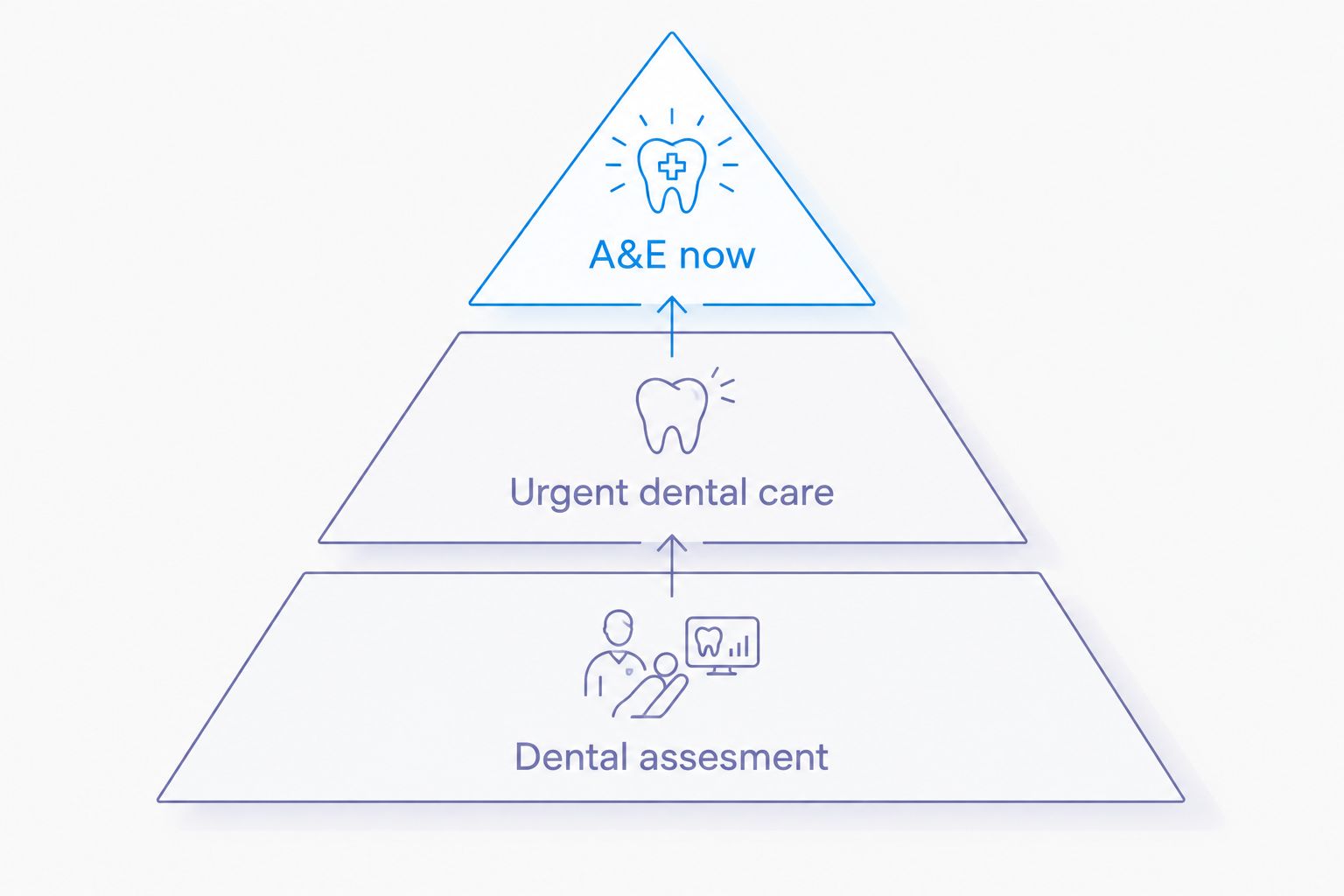
Your symptoms can change between booking and arrival. If a hospital warning sign develops, follow the emergency guidance rather than waiting for the appointment you already arranged.
Booking emergency dental care in Whitechapel
Emergencysmiles offers same-day emergency dental care in Whitechapel, including out-of-hours appointments. The clinic provides a 24-hour service, but you should confirm your appointment arrangements before travelling.
Use the contact page to ask for care. Explain your symptoms first, then give the practical details that help the clinic understand your situation:
- When the pain, swelling or injury started.
- Whether symptoms are getting worse.
- Whether you have fever, bleeding or difficulty opening your mouth.
- Any medicines, allergies or relevant health conditions.
- Whether you are booking for a child or feel anxious about dental treatment.
For your 2026 visit, the £20 emergency visit fee is not the cost of treatment. Any treatment costs are discussed separately; ask what is included before agreeing to care.
Arrange emergency dental care
Describe your symptoms and ask about a same-day appointment at the Whitechapel clinic.
What happens if you are nervous?
Tell the clinic before your visit if you are frightened, have had a difficult dental experience or need explanations before anything happens. You do not need to minimise your fear to ask for help.
An emergency dental assessment involves discussing your symptoms and examining the problem. The dentist explains the findings and treatment options; ask about breaks, a stop signal and costs before treatment begins.
An emergency appointment is an opportunity to understand the problem, not a promise of a particular procedure or outcome. Say what worries you most, whether that is pain, needles, cost or not knowing what comes next.
FAQ
What are the most urgent dental symptoms in Whitechapel?
Breathing or swallowing difficulty, heavy bleeding that will not stop, and a knocked-out adult tooth need the fastest action. Breathing difficulty requires 999; a knocked-out adult tooth needs immediate dental attention.
Should I go to A&E for toothache?
Toothache without serious warning signs usually needs a dentist rather than A&E. Attend A&E for uncontrolled heavy bleeding, serious facial injury or swelling affecting the eye; call 999 for breathing difficulty or another life-threatening emergency.
Can I get a same-day emergency dental appointment in Whitechapel?
Emergencysmiles offers same-day emergency dental appointments in Whitechapel. Contact the clinic to explain your symptoms and confirm arrangements before travelling.
What is the emergency visit fee in 2026?
The emergency visit fee is £20, not the total cost of treatment. Treatment costs are discussed separately, so ask what is included before agreeing to care.
How quickly should I see a dentist for a knocked-out adult tooth?
Seek dental help immediately; reaching a dentist within 60 minutes gives a knocked-out adult tooth a better chance of being saved. Handle it by the crown, keep it moist and never reinsert a baby tooth.
Is facial swelling urgent even if my tooth does not hurt much?
Yes, facial or gum swelling needs prompt dental assessment even when pain is mild. Breathing or swallowing difficulty, eye symptoms or rapidly worsening swelling require emergency medical attention.
What should I say if I am scared of emergency dental treatment?
Tell the clinic that you are anxious and explain what worries you before the appointment. Ask the dentist to explain each step, discuss breaks and agree a stop signal before treatment.
One last thing
A tooth becoming less painful does not prove that the problem has healed. If swelling, discharge or feeling unwell continues, keep seeking assessment rather than cancelling because the pain has eased.
For emergency dental decisions in 2026, use the most serious symptom—not the loudest pain—as your guide.
Related guides